
 EN


Operational Amplifier Circuit Design for Microvolt Signals with the ET85502 Zero-Drift Op Amp
 2026/10/23
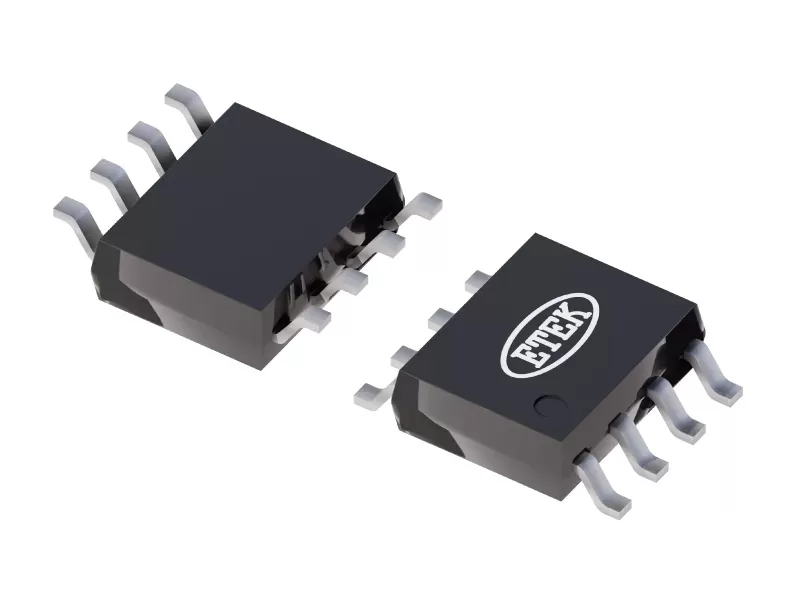
In a precision sensor front end, the operational amplifier circuit often decides how much error reaches the final measurement. When the signal is only a few microvolts, the op amp’s offset, drift and bias current can easily exceed the signal itself.
ETEK’s ET8550X is a zero-drift operational amplifier family that delivers 1µV typical offset and 0.005µV/°C drift without external capacitors. In this article you will learn:
- Which op amp parameters dominate error in precision circuits
- The verified specifications of the ET8550X
- Four practical circuit ideas for sensing and instrumentation
- Layout tips that protect microvolt-level accuracy
What Is a Zero-Drift Operational Amplifier?
A zero-drift operational amplifier uses internal auto-correction, such as auto-zeroing or chopper stabilization, to keep the input offset voltage and its temperature drift extremely low. This lets an operational amplifier circuit amplify microvolt signals without trimming or frequent temperature calibration.
What Limits Accuracy in an Operational Amplifier Circuit?
Four parameters usually dominate the error budget:
- Input offset voltage (VOS): appears at the output multiplied by the closed-loop gain.
- Offset drift: changes VOS with temperature, so a room-temperature calibration cannot remove it.
- Input bias current (IB): flows through source and feedback resistors, creating extra voltage error with high-impedance sensors.
- CMRR and PSRR: set how much common-mode noise and supply ripple leak into the output.
For example, in a gain-of-1,000 bridge amplifier, every 10µV of offset becomes 10mV at the output. That is why precision designs have traditionally relied on expensive auto-zero or chopper amplifiers.
ET8550X Key Specifications
The ET8550X is a single-, dual-, and quad-channel, rail-to-rail input and output precision operational amplifier family. All values below are typical specifications from the ET8550X datasheet (Rev 1.1):
| Parameter | ET8550X Series (Typ.) |
|---|---|
| Channels | 1 (ET85501), 2 (ET85502), 4 (ET85504) |
| Supply voltage | 2.7V–5.0V single supply |
| Input offset voltage | 1µV |
| Offset drift | 0.005µV/°C |
| Input bias current | 20pA |
| Open-loop gain, CMRR, PSRR | 130dB |
| Gain bandwidth product | 1.5MHz (VS = 5V); 1MHz (VS = 2.7V) |
| Slew rate | 0.4V/µs (VS = 5V); 0.5V/µs (VS = 2.7V) |
| Supply current | 770µA per amplifier |
| Overload recovery time | 50µs |
| Operating temperature | -40°C to +125°C |
| Packages | SOT23-5 (ET85501EA), SOP8 (ET85502M), MSOP8 (ET85502U), SOP14 (ET85504M), TSSOP14 (ET85504V) |
Gain bandwidth product (GBP) and slew rate vary slightly with supply voltage: at VS = 5V the typical GBP is 1.5MHz with a 0.4V/µs slew rate, while at VS = 2.7V the typical GBP is 1MHz with a 0.5V/µs slew rate.
Why the ET8550X Suits Precision Circuits
Near-zero drift from -40°C to +125°C
With 0.005µV/°C drift, offset changes by well under 1µV across the full operating range. In many designs this removes the need for offset trimming and temperature calibration.
20pA input bias current
Low bias current keeps errors small even with high-value resistors or high-impedance sources such as bridge sensors and photodiodes.
Rail-to-rail input and output
The common-mode range includes both rails, and the output swings rail to rail. This simplifies high-side and low-side current sensing and maximizes dynamic range on 3.3V or 5V supplies.
No external capacitors
Unlike some chopper-stabilized amplifiers, the ET8550X needs no external capacitors. That saves board space and BOM cost.
Four Operational Amplifier Circuit Ideas Using the ET8550X
1. Strain gauge and pressure sensor amplifier
A Wheatstone bridge outputs a small differential signal. The ET8550X datasheet lists strain gauge amplifiers among target applications, where the dual channel, 130dB CMRR and 1µV offset help preserve accuracy at high gain. In practice, designers often place the two amplifiers in a classic instrumentation front end so the bridge’s microvolt-level differential reaches the ADC with minimal offset and common-mode error.
2. Low-side precision current sensing
With a small shunt resistor, the sense voltage may be only a few millivolts. Rail-to-rail input allows sensing right at ground, while low offset keeps error low at small currents.
3. Thermocouple and RTD front ends
Thermocouples produce only tens of microvolts per degree. A zero-drift amplifier prevents its own drift from being read as a temperature change.
4. Portable medical instrumentation
Battery-powered medical devices need precision at low voltage. The 2.7V minimum supply and 770µA per channel suit these requirements.
PCB Layout Tips for Precision Op Amp Circuits
- Place external components as close to the device as possible to reduce parasitic errors.
- Route input traces away from supply lines and digital signals.
- Decouple the supply pins close to the device with low-ESR ceramic capacitors.
- Keep the thermal environment around both inputs symmetrical to avoid parasitic thermocouple effects at solder joints.
Need a single channel in a tiny package? See the ET85501 product page. For low-voltage IoT signal conversion, read our article on low-voltage operational amplifiers.
Frequently Asked Questions
What makes an operational amplifier circuit “precision”?
A precision operational amplifier circuit keeps total error—mainly offset, drift and bias-current error—below the resolution the system needs. With the ET8550X, typical offset is 1µV and drift is 0.005µV/°C, so the op amp contributes very little error even at high gain.
Can the ET8550X run from a 3.3V supply?
Yes. The ET8550X operates from a single 2.7V to 5.0V supply, so 3.3V systems are fully supported. At lower supply voltages the gain bandwidth product drops from 1.5MHz to about 1MHz, which is still ample for most sensor and measurement applications.
Does the ET8550X need external capacitors?
No. The ET8550X delivers zero-drift performance without external capacitors. This differs from some chopper-stabilized amplifiers that require external components, so designers save board space, reduce BOM cost and simplify the layout of compact sensor modules.
Is the ET8550X suitable for high-temperature environments?
Yes. The ET8550X is specified across an operating temperature range of -40°C to +125°C, making it suitable for demanding industrial and extended-temperature sensing environments.
Conclusion: Build Microvolt-Accurate Front Ends
For any operational amplifier circuit where every microvolt counts, the ET8550X combines zero-drift precision, rail-to-rail flexibility and a -40°C to +125°C operating range without external capacitors.
👉 Visit the ET85502M/U product page to explore detailed specifications and download the datasheet
✉️ Request Sample: https://www.etekmicro.com/sample


