
 EN


1A Linear Battery Charger IC: Balancing Reliability, Standby Loss, Charging Time, and Cost
 2026/10/16
Charging solutions for single-cell lithium portable devices are always a trade-off among four factors: input overvoltage reliability, standby power loss, charging time, and cost.
The industry pain points are familiar. A misconnected high-voltage adapter burns out the charger IC. Excessive battery leakage shortens standby time. Adding external protection devices pushes up BOM cost and PCB area. Every engineer working on e-cigarettes, smart toys, wireless speakers, or charging docks has met at least one of these problems.
ETEK’s 1A linear battery charger IC product line was built around exactly these four tensions. Covering the 0.8A–A charge-current range with multiple packages and feature options, the family gives designers a way to resolve the trade-offs instead of choosing between them. This article walks through the lineup, the flagship specifications, and two real design wins.
The 1A Linear Battery Charger IC Product Matrix
One charger IC rarely fits every portable product. ETEK’s linear charger family therefore covers multiple specifications so that each application can find a matched device:
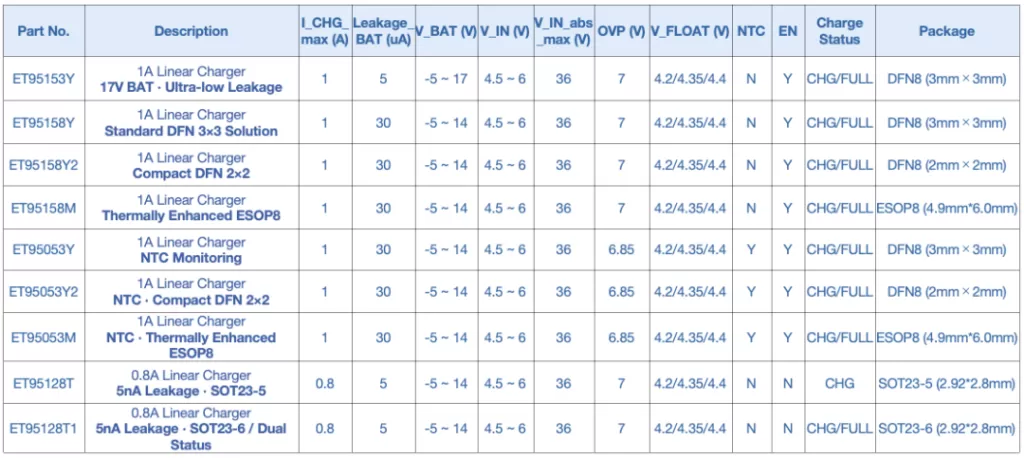
All four series the same design philosophy: integrate the protection that portable products actually need, so the external circuit stays minimal.
Flagship Product: ET95153 36V/1A Linear Battery Charger IC
The ET95153 is the flagship of the family and illustrates an integrated linear battery charger IC should carry today.
Core specifications:
| Parameter | Value |
| Charge current | 1A (programmable) |
| Input operating voltage | 4.5V – 6V |
| Maximum input withstand | 36V |
| Input overvoltage protection | 7V (typical) |
| Float voltage options | 4.2V / 4.35V / 4.4V |
| BAT pin transient tolerance | 17V (1s max) |
| BAT leakage current | 5nA (typical) |
| Package | DFN8 (3.0mm × 3.0mm) |
Integrated features: reverse-blocking MOSFET, current, and loop compensation built into the power stage; dual CHG/FULL charge-status indication; EN charge-enable control; UVLO and OVP; battery reverse-connection protection; and 140°C thermal regulation that reduces charge current instead of shutting down when temperatures rise.
Three of these specifications deserve a closer look, because they define the device’s competitiveness.
What Makes the ET95153 Competitive
1.17V BAT transient tolerance — margin for abnormal conditions.
Hot-plug events send spikes straight to battery pin. A 17V (1s) transient rating lets the IC absorb plug-in spikes and survive accidental high-voltage contact, directly reducing field damage. For products like e-cigarettes that are plugged and unplugged many times a day, this margin not optional.
2.5nA battery leakage — standby that lasts.
When the input source is removed, the charger must not drain the battery. At 5nA typical BAT leakage, the ET95153 keeps battery loss at the nanoamp level, dramatically extending shelf time and standby endurance. Products can sit in a warehouse or on a store shelf for months and still power on out of the box.
3.Selectable 4.2V /4.35V / 4.4V float voltage — one IC, multiple cell types.
High-energy-density lithium cells increasingly charge to 4.35V or 4.4V. Selectable float voltage lets the same charger IC serve different cell across product generations, without redesigning the charging circuit.
Four Typical Applications
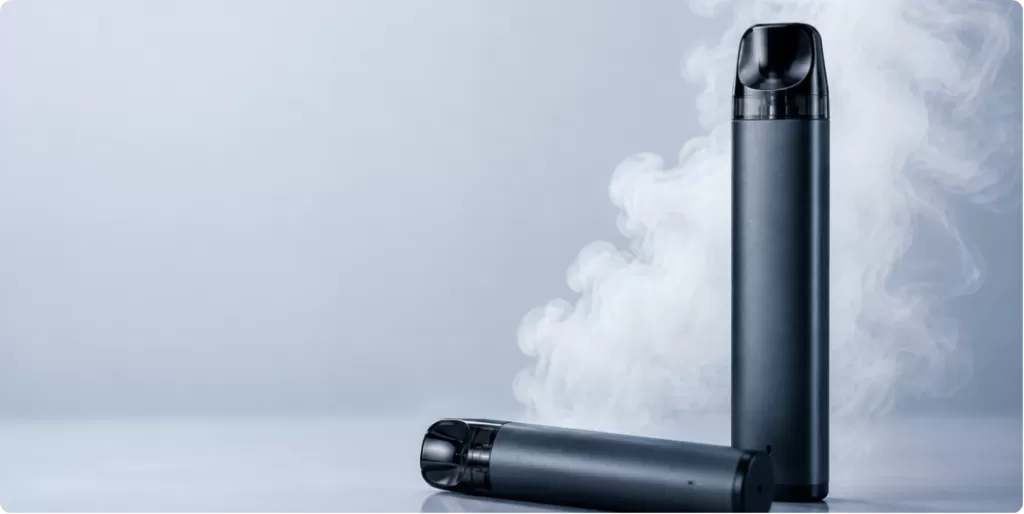
E-cigarettes — ET95153 series. Fast charging around the 50-minute class, ultra-low leakage for standby, and high BAT tolerance for constant plug cycles.
Smart toys — ET95128 series. A small package and simplified interface keep the design compact and cost-effective, while low leakage protects battery life between play sessions.
Wireless speakers — ET95053 series. NTC temperature monitoring adds battery safety during long playback, 44V support enables high-density cells, and the thermally optimized package manages heat in enclosed enclosures.
Charging docks — ET95158 series. Full 1A charging with multiple package options and complete status indication gives dock designs flexibility in both mechanics and user experience.
The selection logic is consistent: from the application’s real stress conditions, then choose the device whose strengths match them.
Stable Mass-Production Delivery
A linear battery charger IC that passes testing must also ship at scale, year after year. ETEK supports this with five foundations:
1.R&D and quality systems: ISO9001, ISO14001, and ISO26262 certified management systems.
2.Wafer manufacturing: partnerships with multiple foundries across a dual China/overseas supply chain.
3.Assembly and test: multiple packaging and test partners working in coordination to secure delivery.
4.Mass-production scale: 3 billion units shipped annually with a field failure below 5 ppm.
5.Global customer support: a worldwide layout for fast response and technical assistance.
For consumer products shipping in volume, these figures belong in the selection spreadsheet next to the electrical parameters.
Design Win 1: E-Cigarette Small Size, Fast Charging, High Reliability
Customer pain points:
– Limited room for cost reduction in the existing solution
– The device must survive 28V contact without IC damage
– Charging time target of about 50 minutes
ETEK solution — ET95153Y:
– 17V BAT transient tolerance
– 5nA battery leakage
– RC optimization to plug-in spikes
Customer value: the abnormal overvoltage requirement and the charging-time target were both met — without adding external protection.
Design Win 2: Wireless Mouse — Convenient Charging, Safety, and Cost Optimization
Customer pain points:
– Risk of damage from misconnected high-voltage sources
– The traditional solution required an additional protection IC
– Extra BOM cost and PCB area
ETEK solution — ET95053Y:
– 36V absolute maximum input voltage
– Integrated 7V OVP
– High BAT-pin withstand
Customer value: the external protection IC was eliminated, reducing BOM cost and saving PCB area in a space-constrained mouse design.
Both cases show the same pattern: the value of a linear battery charger IC comes not from the charging function alone, but from the integration around it.

Conclusion
Choosing a 1A linear battery charger IC for single-cell portable devices means resolving four tensions at once: overvoltage reliability, standby loss, charging time, and cost. The ETEK charger family addresses them through high input withstand (36), 17V BAT transient tolerance, 5nA battery leakage, selectable float voltages, and fully integrated protection — backed by 3 billion units of annual shipment experience at under 5 ppm field failure.
👉 Explore the full linear battery charger IC portfolio
✉️ Request Sample:https://www.etekmicro.com/sample


