
 EN


Energy Harvesting IC for Indoor Light: How to Power IoT from 50 Lux
 2026/10/19
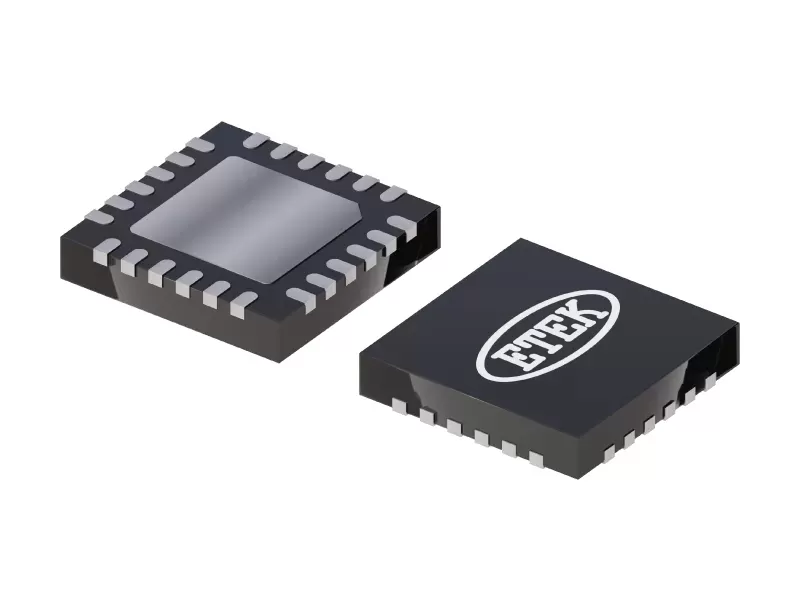
An energy harvesting IC is what makes indoor solar practical. Office and home lighting delivers only microwatts to a small photovoltaic (PV) cell, and a standard DC-DC converter can consume more than that just to stay on. A dedicated harvester starts from a few hundred millivolts, tracks the cell’s best operating point and stores every microwatt in a battery.
In this article you will learn:
- Why indoor light is a very different energy source from sunlight
- Which PV materials suit low-light conditions
- The three power-management problems indoor harvesting must solve
- How ETEK’s ET95640 and ET9PW64 energy harvesting ICs address them
What Is an Energy Harvesting IC?
An energy harvesting IC is a power management chip that extracts energy from ambient sources such as indoor light or thermoelectric generators (TEGs). It cold-starts from very low voltage, converts the energy efficiently, charges a storage element, and supplies a regulated rail to sensors, MCUs and radios.
Why Indoor Light Is Hard to Harvest
Two to three orders of magnitude less light
Outdoor sunlight typically reaches 10,000–100,000 lux. Indoor spaces usually offer only 50–1,000 lux. With the same cell area, the energy available indoors can be hundreds or thousands of times lower.
A narrower, peakier spectrum
Sunlight spans from ultraviolet to infrared. Indoor sources are concentrated in the visible band (about 400–700nm):
- Fluorescent lamps: sharp peaks, for example near 546nm and 611nm
- White LEDs: a strong blue peak near 450nm plus a broad phosphor band
- Incandescent lamps: close to black-body radiation, with most energy lost as infrared
The PV cell therefore receives weak light with a visible-only spectrum, and the power stage behind it must cope with both.
Which PV Materials Work Best Indoors?
A photon generates an electron-hole pair only if its energy exceeds the material’s bandgap. Visible indoor light corresponds to about 1.77–3.10 eV, so wider-bandgap materials match it better.
| Material | Bandgap (eV) | Indoor efficiency | Notes |
|---|---|---|---|
| Amorphous silicon (a-Si) | 1.7–1.8 | Medium | Mature, low cost |
| Crystalline silicon (c-Si) | ~1.12 | Low | Strong outdoors; low open-circuit voltage indoors |
| Organic PV (OPV) | 1.5–2.0 (tunable) | Medium | Flexible, semi-transparent; stability still being proven |
| Perovskite | 1.5–1.6 (tunable) | High | Tunable bandgap, low-temperature processing |
Perovskite cells look especially promising. Laboratory perovskite indoor cells have achieved power-conversion efficiencies well above 30% under LED illumination (commonly tested near 1,000 lux), with peer-reviewed results ranging from about 32% to more than 40%. A 2025 Nature Reviews Clean Technology survey of indoor photovoltaics and a 2024 Energy & Environmental Science report (44.72% under indoor light) both document this performance range. Yet even the best cell solves only half the problem.
Three Problems an Energy Harvesting IC Must Solve
1. The harvested power is tiny
A small indoor PV cell may deliver only microwatts to tens of microwatts. Conventional converters often draw hundreds of microwatts of quiescent power. In that case the chip consumes more than the cell produces.
ETEK’s approach: a built-in cold-start circuit operates from 275mV. The ET95640 starts from 275mV / 5µW, and the ET9PW64 from 275mV / 2µW. On the ET95640, battery-side quiescent current (typ., TA = 25°C) is 400nA with SYS disabled in discharge mode (IBAT1) and 350nA with SYS disabled after charge-done (IBAT2); with SYS enabled the figures rise to 650nA / 550nA.
2. The input voltage keeps moving
Indoor light ranges from about 50 lux in a corridor to 10,000 lux beside a window. A cell’s open-circuit voltage (VOC) can shift by more than 100mV, approaching 1V across four cells in series. A fixed operating point wastes energy most of the day.
ETEK’s approach: a boost stage charges the battery while regulating the harvester’s input voltage, so the source is never collapsed. Maximum power point tracking (MPPT) is offered in two forms across the family: fixed-voltage regulation (ET95640, ET9PW64, ET9504XXX set VPV_CELL,REG via pins, typically 0.25–3.2V) and adaptive VOC-fraction tracking (ET95641 and ET9PW65). On the adaptive parts, MPPT_R[2:0] selects VMPPT/VOC ratios of 35%, 50%, 65%, 70%, 75%, 80%, 85% or 90%, and the IC periodically samples VOC. Up to 110mA can be extracted from the source.
3. Energy must be stored and released on demand
Harvesting is slow and continuous, but sensors and Bluetooth radios draw power in bursts. The system needs safe storage and an efficient output rail.
ETEK’s approach (ET95640):
- Selectable over-charge and over-discharge protection for LiC, Li-ion and LiPo cells
- Battery voltage settings within 2.4V–4.4V
- Buck output with efficiency above 90% and up to 135mA (ET9PW64: up to 120mA)
- 5V linear charger with pre-charge/CC/CV modes when no light is available
- Shipping mode with less than 10nA battery leakage
- Configuration by GPIO
ETEK Energy Harvesting IC Family at a Glance
| Feature | ET95640 | ET9PW64 |
|---|---|---|
| Cold start | 275mV / 5µW | 275mV / 2µW |
| Max. current from harvester | 110mA | 110mA |
| Buck efficiency | >90% | >90% |
| Buck output current | Up to 135mA | Up to 120mA |
| 5V linear charger | Yes | Yes |
| Shipping-mode leakage | <10nA | <10nA |
| Package | QFN24 (4mm × 4mm) | QFN24 (4mm × 4mm) |
| MPPT | Fixed voltage (0.25–3.2V) | Fixed voltage (0.25–3.2V); perovskite-optimized |
The wider family, per ETEK’s Chinese product selector and the individual datasheets:
| Part | MPPT | Positioning | Package |
|---|---|---|---|
| ET95640 | Fixed 0.25–3.2V | General-purpose harvester | QFN24 4×4 |
| ET95641 | Adaptive 35%–90% of VOC | Adaptive-MPPT sibling of ET95640 | QFN24 4×4 |
| ET9PW64 | Fixed 0.25–3.2V | Optimized for perovskite solar panels | QFN24 4×4 |
| ET9PW65 | Adaptive 35%–90% of VOC | Optimized for perovskite + adaptive MPPT | QFN24 4×4 |
| ET9504XXX | Fixed 0.25–3.2V | Compact fixed-option part | DFN10 3×3 |
Typical Applications
- Smart home: wireless sensors, thermostats, smart door locks
- Building automation: light sensors, occupancy detection, HVAC monitoring
- Wearables: auxiliary charging for smartwatches and health bands
- IoT nodes: maintenance-free wireless sensing and data logging
- Electronic labels: electronic shelf labels (ESL), logistics tracking
- Consumer devices: remote controls, wireless keyboards
For a system-level view, see our earlier article on ETEK’s energy harvesting solution for low-power IoT.
Frequently Asked Questions
Why can’t I use a standard DC-DC converter with an indoor solar cell?
Most standard converters need a higher start-up voltage and draw more quiescent power than an indoor cell can supply. A dedicated energy harvesting IC such as the ET95640 cold-starts at 275mV and draws only hundreds of nanoamps, so the harvested energy reaches the battery instead of being lost in the converter.
What is the minimum light level for an energy harvesting IC to work?
It depends on the PV cell’s size and material, not only on the IC. The datasheets specify cold-start in electrical terms: 275mV and 2–5µW from the source. An ETEK application article also describes cold start at 275mV / below 50 lux for a-Si, OPV and perovskite cells with the ET95640/ET95641 family. The lux figure is application guidance tied to typical cells; the guaranteed start conditions remain the electrical limits in the datasheet.
Can the ET95640 harvest energy from thermoelectric generators?
Yes. The ET95640 is designed for high-impedance DC sources, including photovoltaic cells and thermoelectric generators (TEGs). Its regulated boost input prevents the source from collapsing, while the built-in battery management and buck output supply the load efficiently.
Which ETEK energy harvesting IC should I choose?
Choose the ET95640 for up to 135mA of buck output with a 5µW cold start and fixed MPPT. Choose the ET9PW64 when the source is weaker (2µW cold start) or when you need a perovskite-optimized fixed-MPPT part. Prefer ET95641 or ET9PW65 when the cell’s MPP moves with light and you need adaptive 35%–90% VOC tracking (ET9PW65 if the panel is perovskite). For ET9504XXX or a custom mix of battery/SYS options, share your PV cell, battery type and load profile with ETEK.
Conclusion: Make Indoor Light a Reliable Power Source
Indoor light is available almost everywhere IoT devices are deployed, but it delivers only microwatts. The right energy harvesting IC turns that into dependable power by starting at 275mV, tracking a moving power point and managing storage with nanoamp-level losses.
👉 Explore the ETEK energy harvest product line and download the ET95640 datasheet
✉️ Request Sample: https://www.etekmicro.com/sample


