
 EN


SIM Card Interface Level Translator for Low-Voltage Host Platforms
 2026/09/17
As smartphone processors continue to move toward lower-voltage architectures, designers face an increasing challenge when connecting modern host processors with traditional SIM card interfaces. While advanced mobile platforms may operate at around 1.2V, SIM cards can require interface voltages of 1.8V or 3.0V.
A reliable level translator provides the bridge between these different voltage domains, allowing the host processor and SIM card to communicate correctly without compromising signal integrity or system reliability.
ETEK’s ET4559 SIM card interface level translator is designed specifically for this application. It supports low-voltage host interfaces from 1.08V to 1.98V and SIM card supply voltages from 1.62V to 3.6V, providing automatic voltage translation for the I/O, RST, and CLK signals.
Why Is a Level Translator Needed for SIM Card Interfaces?
A SIM card interface typically includes several signals that must communicate between the host processor and the SIM card. However, the voltage levels supported by these two devices are not always the same.
Modern application processors and baseband platforms increasingly use lower core and I/O voltages to reduce power consumption. In contrast, SIM card interfaces may operate at higher voltage levels according to their operating requirements.
Directly connecting signals across incompatible voltage domains can result in incorrect logic recognition, excessive electrical stress, or unreliable communication. A dedicated level translator solves this problem by converting signal voltage levels while maintaining the required timing and communication characteristics.
For SIM applications, the translator must also handle bidirectional communication and comply with industry interface requirements.
ET4559: Three-Channel SIM Card Level Translation
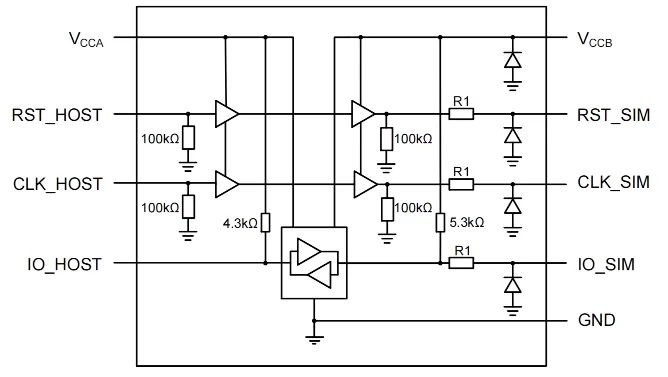
The ET4559 integrates three level translators for the main SIM card interface signals: I/O, RST, and CLK. The I/O channel supports bidirectional communication, while RST and CLK operate as unidirectional signals.
The device supports a host-side voltage range of 1.08V to 1.98V and a SIM card-side voltage range of 1.62V to 3.6V. This wide voltage range makes the ET4559 suitable for low-voltage mobile platforms while supporting different SIM card operating conditions.
The device supports clock speeds of up to 10MHz and provides automatic level translation between the host and SIM card sides. It also incorporates capacitance isolation and automatic enable/disable control through VCCB, helping simplify system implementation.
Integrated EMI and ESD Protection
Signal integrity is particularly important in compact mobile and wireless designs. High-speed digital signals can generate unwanted harmonics and electromagnetic interference if they are not properly controlled.
The ET4559 integrates EMI filtering to suppress higher-frequency harmonics on digital I/O signals. It also provides 8kV ESD protection according to IEC 61000-4-2 Level 4 on SIM card contact pins. The integrated level-shifting buffers use a zero-clamping concept to help keep ESD stress away from the host processor.
These integrated protection functions can reduce the need for additional external components and help simplify PCB design.
Compact Package for Space-Constrained Designs
Modern smartphones, wireless modems, and IoT devices require increasingly compact PCB layouts. Component size therefore becomes an important consideration alongside electrical performance.
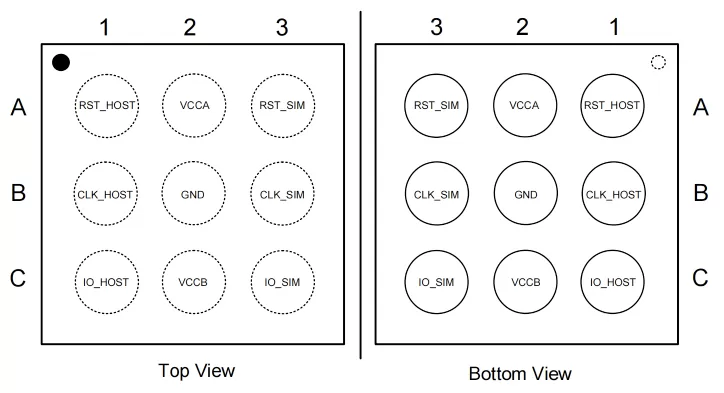
The ET4559 uses a FOWLP9 package measuring approximately 1.06mm × 1.06mm, helping reduce PCB area compared with larger conventional packages. Its compact form factor is suitable for high-density designs where board space is limited.
The device also integrates pull-up and pull-down resistors, eliminating the need for certain external resistors and further simplifying the surrounding circuit.
Applications of the ET4559 Level Translator
With its low-voltage host interface, multi-channel translation, protection functions, and compact package, the ET4559 is designed for applications including:
– Mobile and personal phones
– Wireless modems
– SIM card terminals
– Compact communication and IoT devices
The device is compliant with ETSI, IMT-2000, and ISO-7816 SIM/smart card interface requirements, supporting reliable communication between the host controller and SIM card.
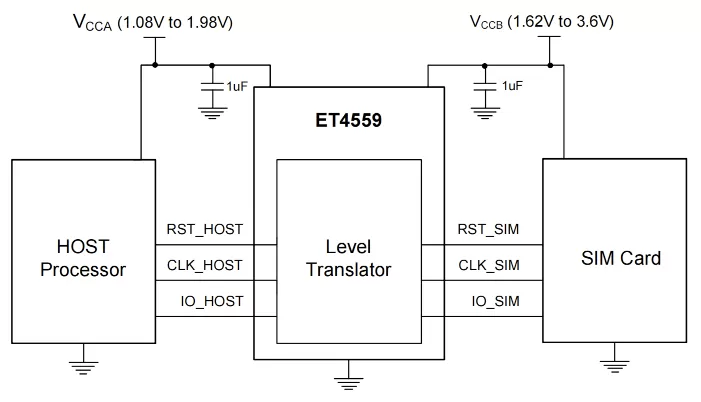
For engineers designing next-generation mobile platforms, selecting the right level translator can simplify voltage-domain interfacing while improving system reliability and PCB integration. ETEK’s ET4559 combines automatic SIM signal translation, EMI filtering, ESD protection, and a compact package in a single device for space-constrained applications.
Learn more about the ET4559 SIM Card Interface Level Translator and contact ETEK for product samples and technical support.
Frequently Asked Questions About Level Translators
Why is a level translator needed for a SIM card?
Modern processors often operate at lower I/O voltages to reduce power consumption, while SIM cards may use higher interface voltages such as 1.8V or 3.0V. A SIM card level translator bridges these voltage domains and allows the host processor and SIM card to exchange signals without directly connecting incompatible voltage levels.
What signals does a SIM card level translator convert?
A typical SIM card level translator handles three primary interface signals: I/O, RST, and CLK. The I/O signal is generally bidirectional because data must travel between the host processor and SIM card, while RST and CLK are typically controlled in one direction from the host side.
This three-channel architecture is also used by several established SIM interface level translator solutions in the market.


